
Amethyst Davis
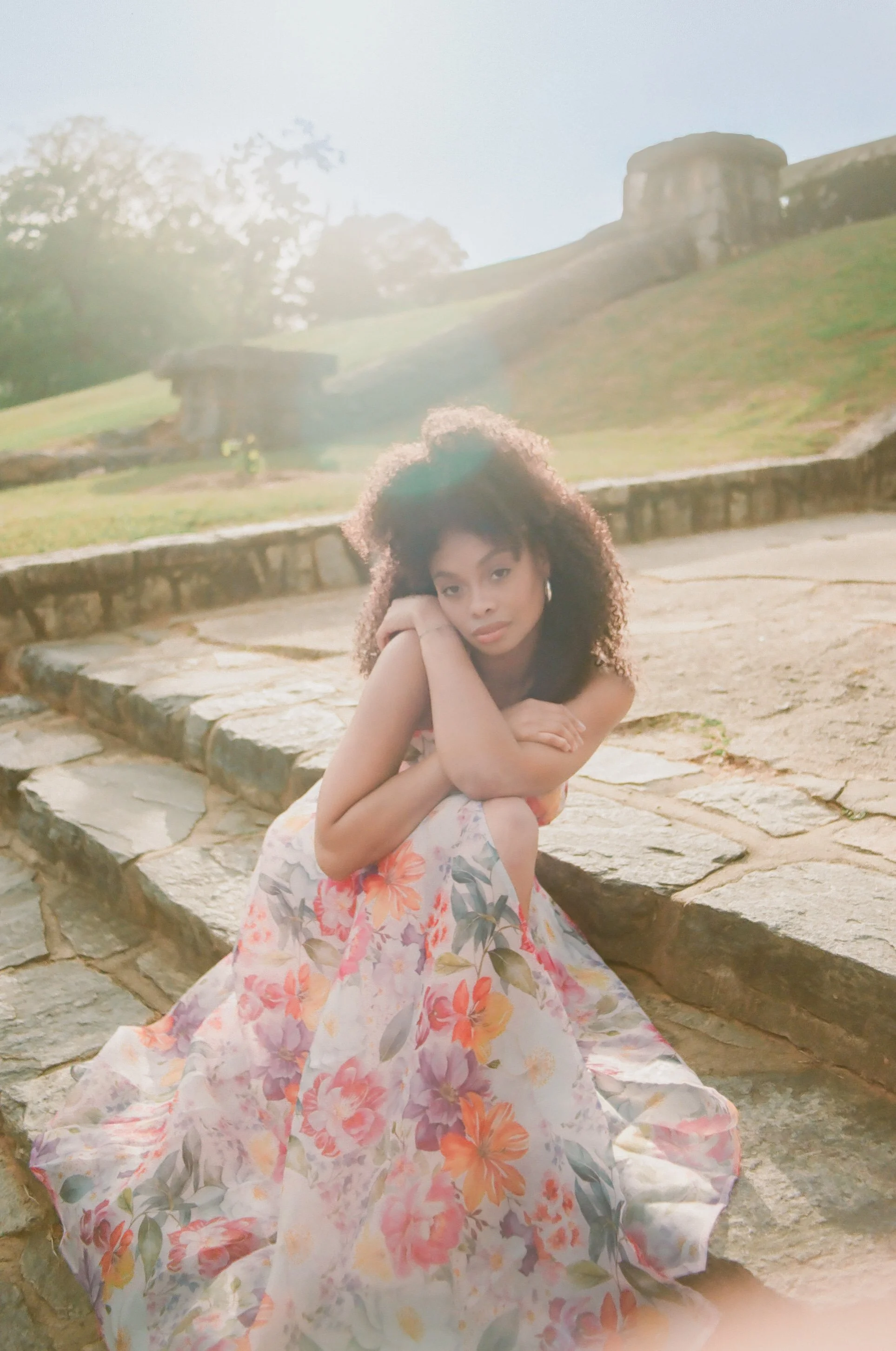
Amethyst Davis
on The Gray House, her career, and knowing yourself
I'll be honest: I wasn't sure I was the right person to sit down with someone whose breakout role lives so squarely inside American history — history I realized, embarrassingly, I didn't know as well as I should have. But that gap turned out to be the whole point. I spent eight hours on a Saturday watching The Gray House before we spoke, and by the end I was genuinely undone — Googling Confederate presidents, dates of Civil War battles, feeling the particular shame of not knowing things that were always there to be known. When I finally sat down with Amethyst Davis, who plays Mary Jane in Prime Video's limited series, I found someone who meets the world, even the heaviest parts of it, with a curiosity so steady it becomes courage. She did stand-in work for years before anyone put her name at the top of a call sheet. And now she's the lead of an eight-episode historical spy thriller produced by Kevin Costner and Morgan Freeman, playing a formerly enslaved woman who was already free, already brilliant, already dangerous by the time the story begins. What I keep thinking about, weeks later, is something Amethyst said about fear — how her anxiety lives in the window before the thing happens, and how once she's there, locked in, there's no room for it. I’d like to live more like that — letting the fear live in that window, and then having the curiosity to walk through anyway. — Cariann, 2026 ◇
〰️
Cariann Bradley: So, Mary Jane was your first leading role, right?
Amethyst Davis: Yes.
Cariann: I know you shot [The Gray House] a while ago—you auditioned in 2022 and then you guys started shooting in 2023. I know it's been a while, but do you have a favorite day from the set during the shoot? Something that stuck with you from that experience?
Amethyst: I would say my first day was pretty interesting because, you know, in episode one when that big fight happens where they drag me—Mary Jane—off the carriage. That was my first day! That whole combat scene and everything. And so I'd never done a combat scene, so that was really fun. The night before, I remember, we did go and do choreography with the stunt coordinator and practiced, then the next day we just did that all day—like all day—for like 12 hours and a break.
Cariann: Oh my god, you're exhausted.
Amethyst: But I was really in shape, too, before I went there. I was really working out before I came because after I’d done three auditions and I had talked to the producers, they just wanted to meet me. They were like, "Oh, we just want to make sure you're in mental health, it's overseas." They were asking all these questions and I was like, "Yeah, I'm not scared of anything like this. I was in the military." And they were like, "What? You're in the military? Oh, so you can do your own stunts." So, I was really working out. I wanted to be in shape or whatever because I don't know what I have to do. I did have stunt doubles, there would be a stunt double there for me, but we would just never use them. So, that was really fun.
Cariann: Wow. Okay. Wait, so you were in the military?
Amethyst: Yeah, I was in the military. I was in the Army Reserve right out of high school. So, I don't personally think that has anything to do with being able to do your own stunts, but the producer was so excited and you know, this is my first lead role.
Cariann: That's really exciting though because I feel like, you know, you kind of got to do everything because you didn't really know what that would mean to say. Where did it shoot?
Amethyst: It was shot in Bucharest, Romania.
Cariann: Oh, I had no idea. I thought it was shot in the States!
Amethyst: So, they didn't use any CGI or anything like that. They built all those sets, handmade dresses, like all those people were real people. This is a cool story, but it would cost a lot of money to shoot it in the States, unfortunately, and because they wanted the story to be grand, it was just easier to shoot it overseas.
Cariann: Wow. Did you shoot on a stage or did they actually build a little Richmond?
Amethyst: No, they built it—it was not a stage. There were stages for rooms, but no. That scene I'm talking about, they built a saloon like a town square. There was a real train station. All this stuff was real.
Cariann: That's so crazy. Had you ever been on a production of that scale before?
Amethyst: Not as an actress. I did a lot of stand-in work before I was an actress, so I got a lot of exposure. I would say Kindred, the show I shot in, it was filmed in Atlanta and it was a lot of stages. It wasn't as many outdoor scenes, but it was still a pretty big set. This had so much that had to be real because it was so much outdoors. It was not a green screen or anything like that. It was real.
Cariann: Wow. Personally, I feel like it would feel like a lot of pressure to go in and represent someone that did exist, that was a real person. I'm wondering, when you started to portray this character, was there ever a point in her story that you started to think of her less as this person on a pedestal and more of a, “Oh, I can actually bring myself to this character and there are pieces of me that I'm bringing to the day.” Like, were there any experiences like that that you had?
Amethyst: I think because of my particular training that I had, I was already doing that from the jump. There's so many different types of acting training and I'm not a classically trained actress—I've taken a lot of different workshops and classes in Atlanta—but at the time, I was working with Sara Mornell. She doesn't coach anymore, but she was a really good acting teacher. Anyway, her whole thing was about bringing yourself to the character. So, that was already the basis of my work.
Now I'm in acting classes where I learn to do the opposite of that because I have a good handle on bringing myself to the character. So now I'm like, “Okay, how do I do this in the complete reverse?” I know me and my nerves; I can't be nervous and anxious because then I'm not going to be able to give a good performance. So I try to just think about the task at hand, not the outcome or people hating it or, you know, anything negative. I try to think about it as if this was an acting class.
I just took it one day at a time. When I met with my acting coach, I was kind of overwhelmed because I had the entire script which was three hundred and something pages and I had like fifty scenes. She was like, "You just take it one scene at a time, Amethyst, just like you always do." And that's really what I did.

Cariann: I would imagine if it was your first time doing something of that magnitude, having that many scenes, that many pages, like you kind of just have to be like, "Okay, I'll break it down into smaller pieces and that's what I'll do." And so there's really no time for nerves because you have to just be present.
Amethyst: No, there's no time for nerves. It was the perfect first-time lead for me because it was such an ensemble cast. I'm not in every scene of these three hundred pages. Daisy Head, who plays Elizabeth, was in way more scenes and she worked a lot of days back-to-back which I didn’t really have to do. Once they put out the scenes for the week, I could just learn all those scenes. But it was impossible when I was still at home trying to learn all fifty scenes. In Kindred, I literally remember I had eleven scenes. I knew all eleven scenes before we started shooting. For this, I was not gonna be able to learn all fifty. That's not gonna happen. I can be familiar, but I didn’t know all of those scenes.
Cariann: It's really scary. I'm not an actor. I've never done acting unless you count, like, the fifth grade play, which we shouldn't count, [laughs] but I do l’Odet, I do these interviews on the side—I'm on my lunch break from my corporate job right now—so whenever I start a new nine-to-five, it's so terrifying. I can't imagine being in your shoes and moving from project-to-project and just having to… I don't know.
I feel like it's a very vulnerable thing to just show up and be like, this is all new and I'm just going to wing it. And actors have to do that so often.
Amethyst: Yeah, I think that I am gifted with being good at first impressions. I enjoy meeting new people, working with new people. I try to think the best of people and then if something happens and there was some type of strife and they come to me with it—it's just a learning experience. It's always a new learning experience. And you're pushed into it. I can't back out. I worked for this. I tried for this. They picked me. I signed a contract. No backing out. You have to do it now. [Laughs]
Cariann: But that's also a really beautiful and optimistic way of working, knowing this is what I worked for. If something bad happens, so be it, but hopefully it'll just go well. And that's, I feel like, a really optimistic way of being, especially when you're approaching such a dark story.
Amethyst: And I think I have the capacity to tell this type of story because I grew up watching The Color Purple—the first time probably at like ten years old—you know what I'm saying? I remember I definitely watched The Green Mile, my grandma had a VHS of it.
I think I just have the ability to tell these things where I'm not damaging myself by going deep and giving myself to this story because I already have the capacity for it.
Cariann: Because you've been exposed to stories like this.
Amethyst: I've been exposed to stories like this. I was already a fan of stories like this.
I know it's kind of anticlimactic, and people love to ask how these stories weigh on me, but I feel like my answer is just not fun, because every part of it I enjoyed. I enjoyed learning about the history. I enjoyed being able to bring it to life. And I wasn't doing any type of method acting that was going to make me feel icky later.
Cariann: Yeah. Hearing you talk about it and the way you kind of approach your practice is really inspiring because I just hear so much optimism from you and so much open-mindedness and curiosity. Honestly, that's what struck me while I was watching the show, I just couldn't stop thinking about how many times our country and people in general have not viewed things with open-mindedness and curiosity and continuously approached things from a place of fear and that's the whole problem. Why does it keep happening again and again and again?
Amethyst: Yeah. I don't know. I've had some ladies back home that tell me, “I can't watch your show. I'm so proud of you, but I physically cannot watch this. I have told everyone else about it. I've shared it on Facebook, but I can't watch it.” And that's okay! I think people have different capacities and people have different gifts and people just have different things that they're here on this earth to do. And hopefully there will be enough people operating their gifts in where they really are supposed to that it can do enough good, you know, just compound into enough good—it's not going to be for everybody.
Cariann: Yeah, I totally get what you're saying. This isn't really the same thing at all, but it just reminded me like, before I created l’Odet and started doing interviews, I started this website called Midnight Woman and I started it during the Me Too movement. It was a place where people could go and tell their stories anonymously; things that had happened to them and experiences they'd had. And I remember people, mostly men, would come to me and be like, "Well, no, I haven't gone on Midnight Woman, it's not for me, it's for survivors and things like that."
But I just find it so interesting that I accepted that and that's fine, but also, shouldn't we sometimes watch things that don't feel like they're for us to exercise that muscle?
Amethyst: I think this is definitely a stretch, but I've grown so much as a person just in being an actress. I used to not understand other people's perspectives. If someone had a different perspective of me, then I would get defensive, and they're not even trying to be defensive. I just hadn't worked that muscle of being around people with a different perspective and figuring out, “Oh, I don't even have to change my perspective to be able to learn something from somebody,” and the more I expose myself to people with different perspectives the less I got defensive.
But I do think that with this type of work about civil rights and my enslaved ancestors, with this being on TV, I do think it is reaching some people that may have been like, "Oh, I wouldn't have watched this." I mean, I've seen people that messaged me on TikTok saying, "Oh, I usually don't watch this, but I'm going to watch it because you're in it." And even if that's like five people, it's still five people, you know?

Cariann: Yeah! I don't know if I would have watched it if I wasn't doing this interview. But I’m really glad I did and I literally locked in for eight hours on Saturday and by the end I was like, "If Uncle Isham dies, I won't be able to take it." [Laughs]
Amethyst: [Laughs] And then I know everyone's barometer is different, but I was trying to tell people it's not over the top with the abuse. There are hard scenes, there are really sad scenes, there's also romance, there's the war aspect—there's a whole bunch of things happening in these eight hours that it’s not just trauma after trauma after trauma.
Cariann: I do think it's like such a learning opportunity because, honestly, I think one of the reasons I don't gravitate toward historical fiction and dramas as much is because when I was sitting there watching it, I was realizing how dumb I felt. I didn't know some of this stuff. I was googling if there was actually a president of the Confederate States of America.
Amethyst: That's what you're supposed to do! [Laughs]
Cariann: I know! But it's uncomfortable to sit down and be like, "Oh, well I grew up in the South and I didn't know this." It's embarrassing! But I think that's a good thing.
Amethyst: It's a good thing!
I started learning that the smartest people know that they don't know everything. Once I opened my mind to that concept, it was so much better. As a young eighteen-year-old, I thought that, you know, I already knew everything, and you don't know anything! You're eighteen years old. So now, I know the smartest people know that they don't know everything.
I did know that South Carolina was the first to secede from the union, because I lived in South Carolina, and I remember my social studies teacher kind of cheering for us being first at something—like, I have this weird fever dream of that stuck in my memory. I didn't know a lot of things and I was just excited to learn. I was excited to be able to go to the African-American Museum of Culture and History in DC for the first time. I went to the Civil War Museum in Richmond and they gave me a whole personalized tour. It was really good.
And at first, for a second, I was worried, "Oh, they're going to choose me." Because you see other actresses and it seems like they're really into this. They have a degree from Harvard in this subject and they read all these books. And I'm not like that. I'm like me. I did my research in the way I did my research and I learned things in real time and I had a great time doing it.
Cariann: Well, like you said, the way in for you was bringing yourself to the character first, which has to yield a certain amount of honesty in the art regardless.
Amethyst: Yeah. And I felt validated in that because the producers and directors were literally like, the main reason they were willing to take a chance on a new actress was because they thought I was authentic—I don't know how authentic you're going to get to a character that lived in the 1800s—but I guess they felt I was the most authentic.
And I heard one of my acting coaches [Sara Mornell] say that the way in is mostly going to be what you already are. The sky's the limit. But most of the time, as a new no-named actor, you need to get really comfortable with the things that you like about yourself and the things you don't like about yourself because those are the things that you're going to play first. Those are going to be the easiest, the most authentic. Yeah, you still need on-camera training. You still need to know technique. You need to know how to audition, conduct yourself on set. You need to know all that stuff, but you need to get real comfortable with who you already are because that's going to be an extension of what you're going to play. And that was true for me.
Cariann: Wow, that's really powerful advice. I'm going to write that down and probably tape it up on my wall. [Laughs] I'm a writer and I've been working on a novel. I'm on the third draft right now, so I just recently went through and wrote all the questions I'm asking about everything in this third draft. And I realized that all the questions I have about the world and all the questions I have about myself are in the story. It's not like I'm reinventing the wheel with anything like genre or dialogue. It's just that I'm still grappling with the same questions I was grappling with before I even started writing the story—I'm just exploring them in a different way.
Amethyst: Yeah, people usually say write about what you know, at least first. In my research of actors and directors and, if I go back and look at my favorite actors, their first jobs—you can see that it was closer to who they were at the time and then as their career expanded, they got to do the super cool stuff that was super far away from them.
It’s the same when I think about if I was going to write a script, it would definitely be loosely based on an experience that I've already had. I would just expand upon it because it's a real story. I think about Abbott Elementary’s Quinta Brunson—her mom was a school teacher in Philadelphia and it's a brilliant show and she watched all the other mockumentaries. She watched The Office and all of those other types of shows and she was a fan of those shows and then she did her take on it based on her mom. It's so simple yet so brilliant and everyone loves it because it's so honest you can't argue with it. Everyone relates.
Cariann: Yeah. I agree. I think you can really tell when something is made by someone who's green to the industry or to the platform. You can tell and feel that enthusiasm and honesty coming through because, I don’t know, they’re not jaded by stuff.
Amethyst: I'm definitely not jaded. I mean not yet, at least. Auditioning and not booking anything over and over again, it does wear on you, but I just know that you're going to not get it way more than you're going to get it. And I have only worked in Atlanta, I haven't worked in LA, you know, so my career is just so weird. I've worked with lots of female directors. I've worked with black directors. So, going over to Bucharest was my first time in Europe, first time working with predominantly white male producers and directors—it was a lot of new experiences being a lead actress. It turned out to be a great learning experience.
All the veterans were really open and helpful. Gave me great compliments and tips and they never made it seem like I couldn’t keep up. Mary Louise [Parker] always gave compliments, "You're so diplomatic. Wow." She was like, "Sometimes when I work with young people, you know, I'm kind of skeptical, but all the young people on this set, y'all are just so eager, so excited, such hard workers." It was fun. Most fun I've had so far in life, probably.
Cariann: All the best people I've ever worked with have never made me feel like I'm too young or too inexperienced.
Amethyst: It's like everyone understood that everyone has something to bring to the table because they can't play Mary Jane, you know?
Cariann: Right. It kind of brings it back to that whole idea of just approaching something with curiosity and optimism, right? And no fear of feeling, I don't know, less than or am I going to be outshined or something.
Amethyst: Yeah. And I do get anxiety and doubts before the thing is happening. So, the window from January, when I was cast, to April, when I flew out was probably when the most anxiety and negative thoughts were happening. Once I get there and I'm on set, it's like my brain is locked in; we're in a flow state. There's no room for negativity. There's no room for anything. It's like I know what to do. If I don't know what to do, I ask a question nicely.
Cariann: Yeah, I feel like I work very similarly. If I don't know, I'm just going to ask and then I'll just figure out the next thing and then keep going.
Amethyst: Yes. Just keep going. And it's easy; the way that they treat actors on set, they're so nice to us because they know they don't want to be mean and mess us up. They're coddling us. They're trying to keep us in this positive bubble. It's like they are treating us like royalty or something, which is kind of the hierarchy of things, but they're doing it for a reason because they don't want you to get in your head or get negative thoughts because then you can't act right. I don't really like the hierarchy thing but then I get it at the same time because you don't want actors to be upset or get in their head or anything. And then you can't get in your head about that.
Cariann: And then it's just a whole vicious circle.
Amethyst: Yeah, it's a whole vicious circle. And with my experience of being a stand-in, like I consciously know that you're only treating me like this because I'm an actress because I've been a stand-in.
It was like finding my inner courage, my inner bravery, even though I could never compare it to what [Mary Jane] did at all, but still finding the truth and the courage and bravery inside myself.
Cariann: Right. I had an experience like that. I went to LA in January, I've only been a couple times, and I went to this really nice dinner with some people and I just felt so out of place. Well, also when I go to LA I'm like, “Guys, I think I'm a redneck. Like I don't think I belong here.” [Laughs]
Amethyst: I feel like that too, girl. I’m like, “Damn! I’m a country bumpkin.”
Cariann: I am not hopping off the plane at LAX with a dream and a cardigan, I feel like a redneck. [Laughs] But we went to this really nice restaurant. Everyone was ordering like ninety dollar plates and it was a restaurant where they were brushing the crumbs off your table. And not so long ago I was working retail. It's just hard to be in those situations and to understand both sides.
Amethyst: Yeah, I definitely understand all the sides, especially being at fine dining Italian restaurants in Europe. You know what I'm saying? And I literally can't read the menu. I literally don't know what this means. I have to look at the pictures and I can't pronounce anything. And you know, I think that's what helps my acting come in because then I just act like I know what's going on. I’ve been to fine dining restaurants in Atlanta, in Raleigh, North Carolina. [Laughs] And then I use humor. I be myself.
I do think I felt the most self-conscious though at the dinners. Not on set, but at the dinners where it's just the producers and stuff talking and then they're asking, "So, what do your parents do?" That's probably where I felt self-conscious, it was then, not on set because I felt like I know what I'm doing here.
Cariann: Yeah, dinners are where I feel the most out of place when it comes to work stuff, I just don't know how to perform. I don't know how to just not act like myself.
Amethyst: It’s definitely a performance. I definitely start performing, but I can still be an extension of myself. I bring myself to the character. I can't all of a sudden learn Italian if I don't know Italian. [Laughs]
Cariann: Right. [Laughs] Well, I did want to ask, which maybe we've already touched on this, but Mary Jane is such a specific character and maybe you hadn't played someone like her exactly before, but I was wondering if there was a part of yourself that the role asked you to meet for the first time. Like if there was a part of yourself that you didn't really know was there.
Amethyst: Yeah. At first I was like, "Yeah, I'm nothing like this," and then it was like, "No, I get it." Like, she's being underestimated and now she's going to prove everyone wrong and now she's going to use that to her advantage. And I'm like, "Oh yeah, actually I do that all the time." I know what that feels like actually—not that it was happening in real time, because everyone was very kind to me and open—but in getting the part, I was the underdog, I did have to prove myself. So, even on the hard days on set where I did have the directors redo a scene again and again, and I'm in my head, “Girl, you can’t mess this up.”
I wasn't thinking of myself, and I don't think of myself as a rebel, or a type of person that would be a martyr, or really put myself on the line to be that brave. [Mary Jane] is like a type of bravery that you kind of only see in books and movies. I didn't see myself as like that in real life. I am outspoken sometimes on one-on-one levels, not on big social media platform levels, but one-on-one. I do stand up for people, even if I'm going to be the butt of the joke, now everyone's going to hate me, or something—like, I could understand that. So it was just really trying… It was like finding my inner courage, my inner bravery, even though I could never compare it to what she did at all, but still finding the truth and the courage and bravery inside myself.
Cariann: Yeah, that's beautiful. And also, who is to say? If the circumstances were different, you could very well be that brave and courageous. You don't know.
Amethyst: Yeah, I don't know. It was definitely cool because I didn't know anything about Mary J. I didn't know she existed. I didn't know the Van Lews existed until I read the audition script and did a quick Google search.
Cariann: But how exciting. I didn't know they existed either and now we're talking about it. How beautiful is that?
Amethyst: And apparently, my friend told me, there was a billboard during International Women's Day of Mary Jane in Charlotte, North Carolina. I didn't even know Mary Jane was just popping up everywhere.
Cariann: Didn't even know y'all knew Mary Jane like this. [Laughs]
Amethyst: Right! So, now everybody wants to act like they knew Mary Jane. [Laughs]
Cariann: Well, do you have any anything coming up that you're working on or anything that you hope to work on soon?
Amethyst: Yeah, I mean I hope to be able to work on anything. I do love historical dramas. I would love to do other periods of time like the 70s. I auditioned for something sci-fi futuristic. I've been auditioning for lots of nerds. So, I kind of see how Mary Jane translates because Mary Jane is a lowkey nerd. She's really smart. She has photographic memory.
Cariann: Which is super sick.
Amethyst: I've been auditioning for lots of modern-day nerds, scientists and neurologists. It's like the same thing: the black girl that everyone is underestimating, but she's the smartest intern of everyone else and is holding everyone together. So, that really excites me that those are the characters that I get to audition for. A couple years ago, I wouldn’t have imagined in my career that that would be the box that people were putting me in. I'm so excited for that.
Cariann: And how beautiful that you have already gotten to embody a role like that and it's taught you that you have that in yourself, right?
Amethyst: Because now I'm like, "Oh, yeah. I mean, I do have an inner nerd. I do have these quirks." I'm really excited to get to play more smart, brave women.
Cariann: Amen! I mean, I don't think we could end on a better note than that.
This conversation has been condensed and edited for clarity.
Interview By Cariann Bradley | edited by Kass Ringo | design by Madeline Westfall | Photos By Jasmine Ringo